Switching machines and systems on AND off WITHOUT RCD tripping
„Clack!“
Many machine and system operators are familiar with this noise and – depending on how often they hear it – fear it, because it means that the residual current circuit breaker has tripped again. The reasons for this can be as varied as the area of application of the machine or system in question.
However, if you hear the unpleasant noise immediately after plugging in the CEE plug or operating the main switch, it is reasonable to suspect that this action could have something to do with it.
If this is the case, there is unfortunately a second problem: once something has been plugged in or switched on, it will inevitably have to be unplugged or switched off again at some point, potentially confronting the person responsible with an unintentionally tripping RCD and the associated disruption to operation.
It doesn’t have to be! – #onandoffOHNEklackck
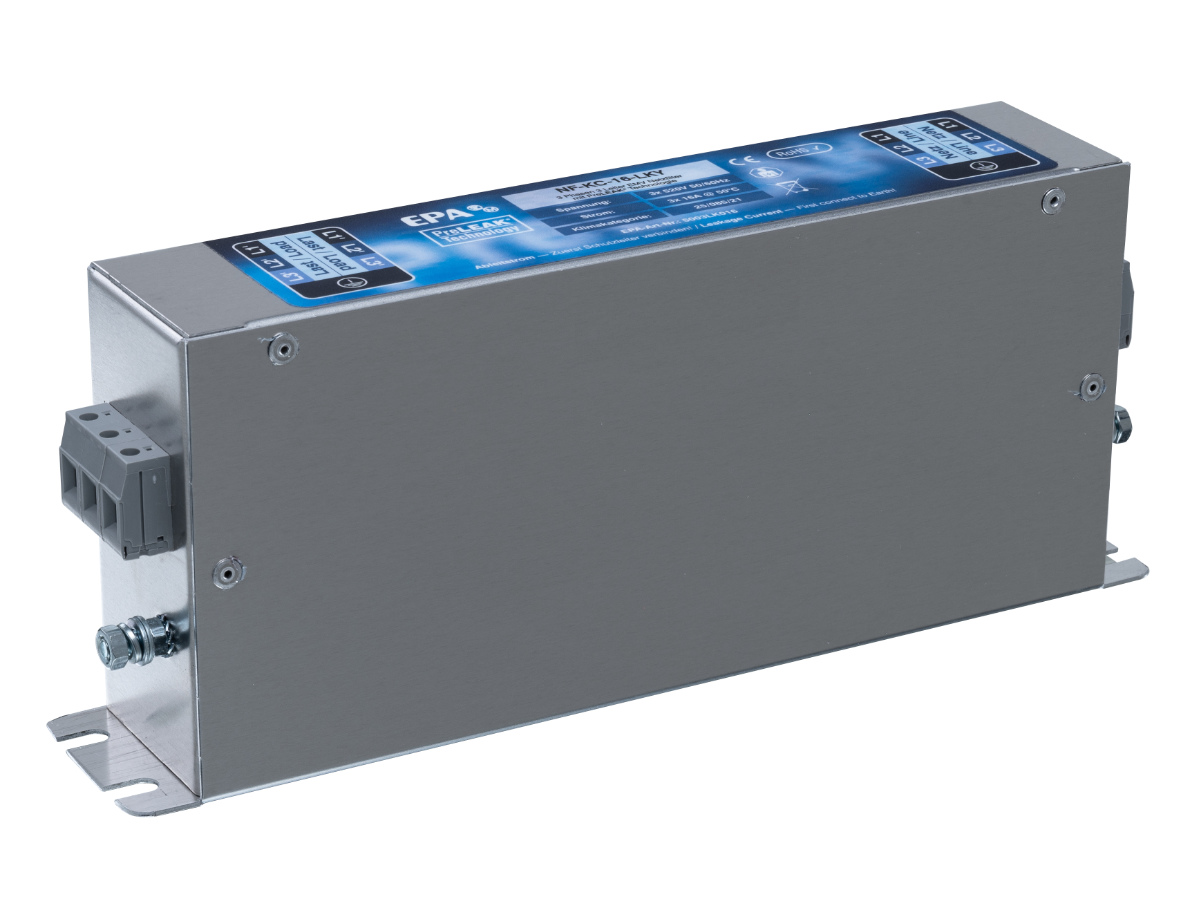
NF-KC-LKY
Netzfilter mit PreLEAK® Technology für den sicheren Betrieb am FI
- No erroneous RCD tripping when switching machines and systems on or off
- No leakage current peaks when plugging and unplugging the CEE plug
- Excellent attenuation properties
- Rated currents from 16A to 125A
| File | Size |
|---|---|
| Brochures » EMC | |
| EPA_NF-KC-LKY_Brochure.pdf | 11.42 M |
| Data_Sheets » EMC » Three_Phase_RFI_Filters | |
| EPA_RFI-filters_NF-KC-LKY_data-sheet.pdf | 825.38 K |
| CAD » EMC » NF » 3ph | |
| NF-KC-LKY_CAD.zip | 426.33 K |
Researching the cause
What exactly is the cause of the problem? The symptom is the residual current circuit breaker, which is functioning correctly but is tripping unintentionally. That is obvious. If you realize that it trips when it is confronted with excessive residual currents, the next step in troubleshooting is also clear: the level of these currents must be measured in order to get a clearer picture of the situation.
Normally, a current or leakage clamp would be used to measure the residual current. However, as measuring clamps only display an actual value, which is subject to a certain inertia, it is not possible to get closer to the cause of the triggering at the moment the plug or switch makes contact.
A suitable means for such a measurement would be an oscilloscope – however, the measurement setup here is comparatively complex. The LEAKWATCH measuring and analysis system from EPA GmbH is much simpler – it has a so-called trigger function that can be used to record and then analyze the moment of tripping.
The problem: a problem solver
If you look at such a recording, you will see that the cause of the problem is a component that should actually be a problem solver: the EMC filter. Leakage currents can emanate from it. That can even trigger residual current circuit breakers with rated residual currents of 300 mA or 500 mA. But how does this happen? A little theory is needed here:
It is the same with a mains filter as with other filters. The useful medium – in this case the current – is filtered and can then be used “cleaned”. The filter material – the filtered part (the interference currents) – must be transported somewhere so that the filter can continue to work.
With mains filters, this “disposal” takes place via the permanent discharge to earth, which generates a residual current. During operation, this generated current is so small that it can be ignored. However, when switching on or off, the mechanical and never fully synchronized process of contact making in combination with the phase asymmetry of the mains results in a short pulse that can cause the residual current circuit breaker to trip.
The solution: PreLEAK® Technology
PreLEAK® Technology is a development of EPA GmbH. With this globally unique technology, we have succeeded in developing a completely new generation of mains filters that do not generate a residual current pulse either when switching on or off.
Sporadically tripping residual current circuit breakers are now a thing of the past and the dreaded “Clack!” has been taken away a large part of its horror!