Electrical engineering encompasses many areas, some of which are very different and specialized, yet inextricably linked. The availability and acquisition of innovative electrical engineering products alone are not always sufficient for customers.
Especially with regard to drive, EMC, and leakage current technology, and for complex projects with special requirements – such as personal and fire protection, compliance with standardized (EMC) limits, the mandatory use of residual current devices, retrofits or predictive maintenance, and on-demand production support – a customized service and comprehensive consulting service are invaluable.
Based on our many years of broad experience, we are able to analyze the entire application and advise our customers throughout the entire project phase, assisting them in selecting suitable devices, including performance and budget considerations. We also act as their active partner during implementation, commissioning, troubleshooting and correction, if necessary, as well as maintenance. We understand the complex relationships between drive, EMC and leakage current technology and have been professionals in all three areas for years.
In short: everything that is feasible can be purchased tailor-made.
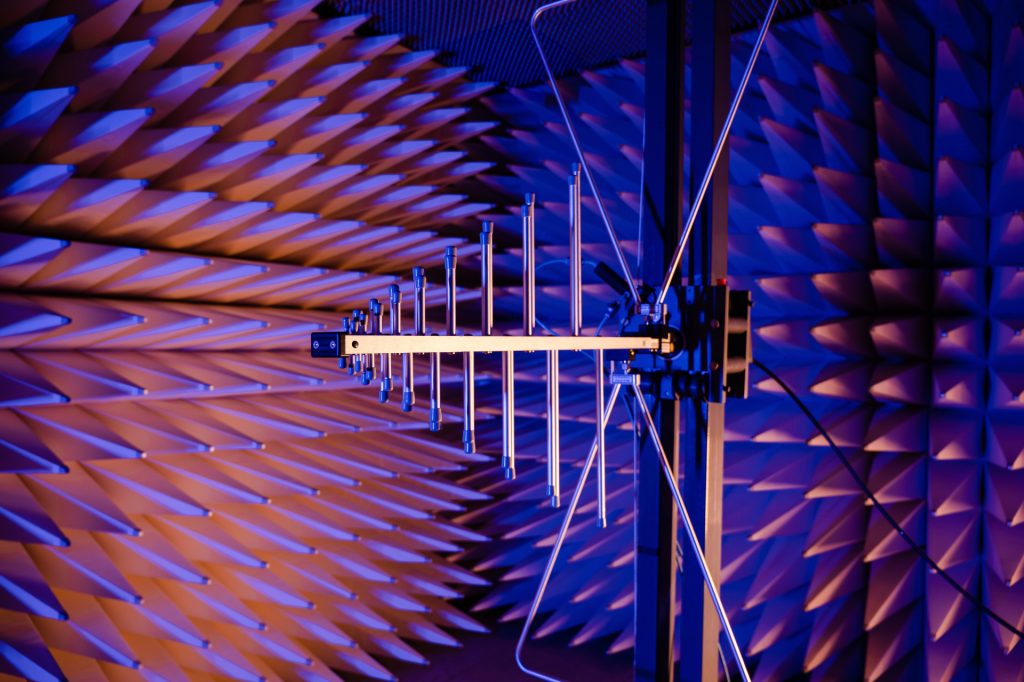
In our test lab
In our in-house, fully equipped EMC test laboratory with absorber cabin, we not only calibrate our own products in accordance with standards, but also offer our customers EMC-relevant measurements of interference emissions and immunity as well as their tests as a service. They are part of our service portfolio for EMC-compliant device and system development and design. As part of EMC consulting, the measurement results can also be recorded during development, for example to check and evaluate the effectiveness of a customer-specific filter solution in the application.
These measurements are possible at our test lab
- Leakage current/residual current measurement (safe operation with an all-sensitive residual current device)
- Measurement of conducted interference with a network simulation up to 63 A (radio interference voltages)
- Measurement of radiated interference (radio interference radiation)
- Immunity tests (surge, EFT/burst, ESD)
- Measurement of interference emissions in the frequency range from 9 kHz to 1 GHz
- Fully automatic measurement of the insertion loss of line filters
- Measurement on a load test bench with a feedback device
- Measurements during development (EMC consulting)
- Measurement at the frequency inverter output (residual current/bearing current measurements)
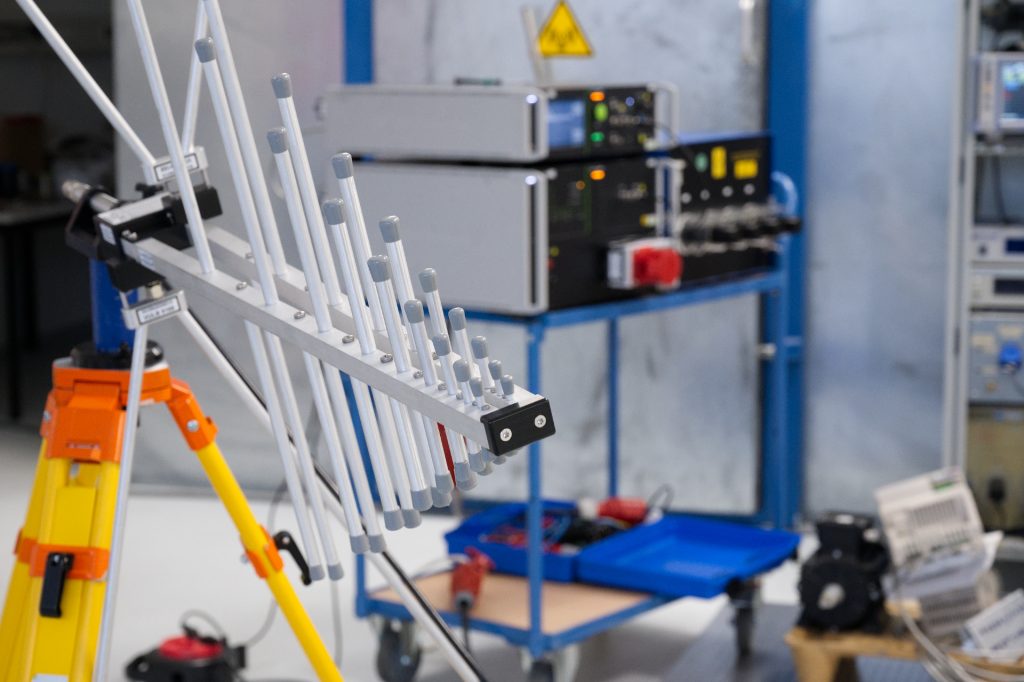
On site
For complex or non-transportable test objects and systems, we also offer comprehensive on-site electromagnetic compatibility measurements – without massive logistical overhead. These EMC analyses also allow us to determine the actual electromagnetic conditions and evaluate the quality of the mains voltage and/or existing radio interference. Taking these external interference influences into account, we use mobile devices, similar to the measuring equipment in the laboratory environment, appropriate to the frequency range to be tested and the interference emission, and measure the test object during normal operation. Ideally, this is done directly at the machine’s site, but can also be performed at the manufacturer’s site before delivery.
The following measurements are possible on site
- Measurement of conducted interference with a network impedance up to 350 A or an RF probe > 350 A (radio interference voltages) 9 kHz to 30 MHz
- Measurement of radiated interference (radio interference) 30 MHz bis 1 GHz
- Immunity tests (surge, EFT/burst, ESD)
- Harmonic analysis
- Measurement of power quality up to 500 A
- General EMC interference measurement and troubleshooting (EMC consulting)
- Measurement at the frequency inverter output (residual current / bearing current measurements)
- Leakage current / fault current measurements (safe operation with an AC/DC sensitive residual current device)
What these measurements exactly mean
Measurement of radio interference voltages
Measurements are performed on a standard-compliant EMC test bench or in an EMC anechoic chamber, either without interference suppression or using an interference suppressor from the EPA standard portfolio. If the application requires modification in design and interference suppression, the effectiveness of this measurement is verified. The measurements are performed using a network (NIR) and an EMC test receiver. The frequency range from 150 kHz to 30 MHz is measured, and compliance with the applicable limit values for the respective product is verified.
Measurement of radio interference radiation
Measurements of the magnetic and electrical components of the field are performed using specially tuned antennas in the anechoic chamber. To determine the location with the maximum emission, the test object is mounted on a turntable that can be rotated 360°. During the measurement, the antenna height is varied and the antenna polarity is switched between horizontal and vertical. The distance between the test object and the antenna is 3 meters. The limits for the radiated field strength are evaluated for the frequency range from 30 MHz to 1 GHz. For on-site measurements, the measurements are performed in the same way as the measurement equipment in the laboratory environment using appropriate mobile devices, using the usual procedure. Based on the acquired measurement results, compliance with the limits can be concluded. However, confirmation of the results can only be achieved in the laboratory environment.
EFT (electrical fast transient) and BURST measurement
In practice, electronic systems usually switch using conventional switching devices (e.g. contactors or relays). All predominantly inductive loads generate a wide variety of parasitic switching signals (also called BURSTs or EFT pulse groups) when switched on and off. The characteristics of such a transient disturbance are rise time (in the ns range), repetition frequency (in the kHz to MHz range), energy (in the mJ range), voltage amplitude (up to several kV), and pulse duration (in ms). To test the influence of these disturbances on devices, pulse packets (bursts) of standardized EFT individual pulses are generated using disturbance generators (EN 61000-4-4).
SURGE (surge voltage) measurement
SURGE refers to high-energy (up to several joules), low-frequency interference pulses with voltages of up to several thousand volts. In addition to switching operations in the power grid, these disturbances also occur during lightning strikes, one of the most energetic sources of interference. Power lines are often used over several kilometers in length. As a result, direct or indirect lightning strikes induce SURGE pulses into the lines, which can interfere with or destroy connected devices. To minimize this risk, special protective elements are used. Surge immunity testing is performed according to DIN EN 61000-4-5.
ESD (electrostatic discharge) measurement
Electrostatic discharge can occur anywhere. Simply walking on an insulating floor surface (e.g. a carpet) can cause a person to become electrostatically charged. The voltage to ground can reach several thousand volts. As soon as the person touches an electrical device or system (often felt and visible through sparks), the discharge occurs. While this is largely harmless to humans, the resulting currents can adversely affect or destroy sensitive electronics. In some cases, entire systems can crash. Explosions and fires are also possible due to this phenomenon. ESD tests are conducted according to EN 61000-4-2.
DIPS (power interruptions and dips) measurement
Voltage interruptions and dips are also known as voltage dips. These unwanted phenomena can occur in the event of a short circuit, when fuses are triggered, or when switching large loads. Interference can occur, for example, as short-term outages or unwanted restarts of devices or systems. The most common causes are switching, inductive loads and switching operations in the public power grid. Immunity to voltage dips, voltage fluctuations, and short-term interruptions is tested according to DIN EN 61000-4-11.
Analysis of harmonics and measurement of power quality
Using special measuring instruments, the harmonic content according to EN 61000-3-2 and EN 61000-3-12 as well as the network quality according to EN 50160 (long-term measurements) are determined on-site.
Leakage current measurement
If problems arise due to the unwanted or faulty tripping of residual current devices, e.g. when using frequency converters, and thus the trouble free yet safe operation of machines and systems can no longer be guaranteed, the EPA LEAKWATCH measurement and analysis system can be used to visualize leakage currents through measurements. The measured values are analyzed and used to determine the cause.
Standards by which EPA measures and tests
Radio interference
voltage measurements
(conducted 9 kHz to 30 MHz)
- EN 61000-6-3
Generic standard for emissions in residential areas and light industry - EN 61000-6-4
Generic standard for emissions in industrial areas - EN 55011
Product family standard for industrial, scientific and medical equipment (ISM) - EN 55014
Product family standard for household appliances, power tools and similar electrical appliances - EN 55015
Product family standard for electrical lighting and similar equipment - EN 50370-1
Product family standard for machine tools - EN 61800-3
Product standard for variable-speed electric drives
Radio interference
field strength measurements
(radiated 30 MHz to 1 GHz)
- EN 61000-6-3
Generic standard for emissions in residential areas and light industry - EN 61000-6-4
Generic standard for emissions in industrial areas - EN 55011
Product family standard for industrial, scientific and medical equipment (ISM) - EN 55014
Product family standard for household appliances, power tools and similar electrical equipment - EN 50370-1
Product family standard for machine tools - EN 61800-3
Product standard for variable-speed electric drives
Immunity tests
- EN 61000-6-1
Generic standard for immunity in residential and light industrial areas - EN 61000-6-2
Generic standard for immunity in industrial areas - EN 61000-4-2
Generic standard for immunity to electrical discharge (ESD) - EN 61000-4-4
Generic standard for immunity to fast transients (burst) - EN 61000-4-5
Generic standard for immunity to high-energy surge voltages - EN 50370-2
Product family standard for machine tools - EN 61800-3
Product standard for variable-speed electric drives
We are happy to check further standards upon request!
Request EMC measurement
CE Conformity Consulting
We also provide advice on electromagnetic compatibility (EMC) issues within the context of CE conformity and on acute EMC issues affecting systems, machines, and equipment.