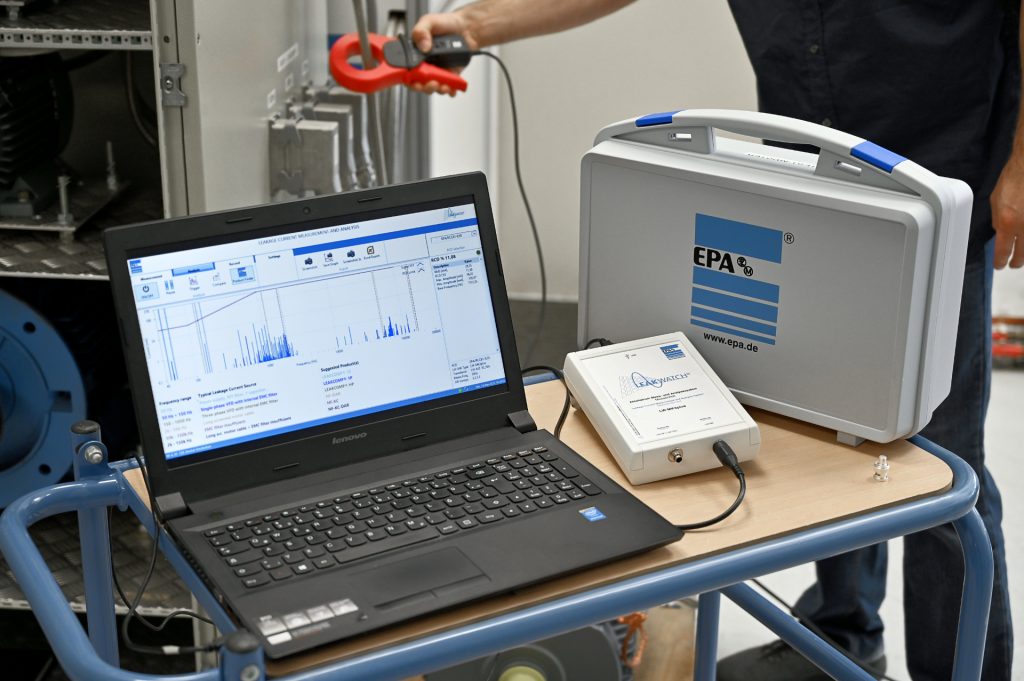
EPA measures the leakage current of devices and systems and helps with unwanted/erroneous residual current device (RCD) tripping! The specially developed EPA LEAKWATCH leakage current measurement and analysis system visualizes residual currents in machines and systems. After a thorough analysis of the measured values, the customer receives valuable information and tips on what measures are necessary and which products we can offer to ensure trouble free, yet safe, operation of the system with a residual current device (RCCB) in the future.
Background knowledge
In the highly dynamic world of industrial drives, AC/DC sensitive residual current circuit breakers (type B/B+) are increasingly being used. This requires EMC-compliant and standard-compliant interaction between all components. However, modern components in automation technology, such as frequency inverters, servo controllers, EMC filters or switched-mode power supplies, generate high leakage currents as a result of the system. In many cases, these can already lead to massive impairments in operation or the protection of people and property. This is because these operational leakage currents are interpreted as residual currents by the RCD protection devices, which often leads to an unsafe operating state or to the RCD being switched off. The reason for this is the fact that the residual current device cannot distinguish between operational leakage currents and genuine residual currents:
It only detects a differential current!
It is possible to measure the level of the leakage current load (e.g. with a leakage current clamp), but there is no information about the individual frequency components and the possibility of assessment in relation to the tripping characteristic of the residual current circuit breaker used (the tripping thresholds differ depending on the type and manufacturer used). Furthermore, many current clamps can only measure up to a certain frequency (e.g. 100Hz), which means that leakage currents flowing at higher frequencies are simply invisible to the clamp.
The LEAKWATCH measuring and analysis system mentioned above was specially developed for measuring leakage currents. In contrast to normal current clamps, a large frequency spectrum can be recorded and a targeted analysis of the individual frequency components can be carried out. It offers the possibility of relating the measurement signal directly to the tripping characteristic of all well-known residual current circuit breakers available on the market. The degree of utilization of the selected residual current device can be recognized immediately by means of a percentage display and coloured traffic light display.
The frequency analysis and a consideration of the effective values of individual frequency components provide valuable assistance in balancing the leakage current and selecting any remedial measures (e.g. low leakage current mains filters, leakage current compensation, etc.). With the EPA LEAKCOMP® devices and leakage current reduction filters, the leakage current can be reduced to a tolerable level for the residual current circuit breaker.
Leakage current reduction
Operating-related leakage currents can be reduced by various measures. Among other things, EPA has particularly low leakage current EMC filters in its range. They are characterized by very low capacitive leakage without impairing the attenuation of EMC interference. Our low leakage current EMC filters LL (low-leakage) are used where, for example, residual current protection devices are required.
If the neutral conductor is available in the supply network, 3-phase EMC filters with neutral conductors can also be used to reduce leakage current. The main leakage with these EMC filters is via the neutral conductor and therefore plays no role in the differential measurement of the protective device.
Leakage current compensation
In single-phase or three-phase applications with frequency inverters or similar devices, further variants of operational, mains-synchronous leakage currents occur with a frequency of 50 Hz (single-phase), 150 Hz (three-phase) and their harmonic oscillations 450 Hz, 750 Hz and 1050 Hz. They are often discharged from the intermediate device circuits via the EMC capacitor to the protective conductor or earth potential. These low-frequency discharges can only be reduced with a great deal of effort using passive components.
EPA GmbH has developed active compensation devices for these leakage currents:
Three-Phase
LEAKCOMP® HP
Compensation of operational leakage currents up to 500 mA (RMS)
Single-Phase
LEAKCOMP® 1P
Fixed compensation of operational leakage currents up to 50 mA (RMS)
Single-Phase
LEAKCOMP® 1C
Fixed compensation of operational 50 Hz leakage currents of 5 / 11 mA
By using the devices described above to compensate for operational leakage currents, it is possible to operate 3-phase or 1-phase inverters/consumers on residual current circuit breakers with a rated residual current of 30 mA or higher in accordance with DIN VDE 0100-530. A safe operating state in compliance with the requirements for personal safety and fire protection is therefore ensured.